
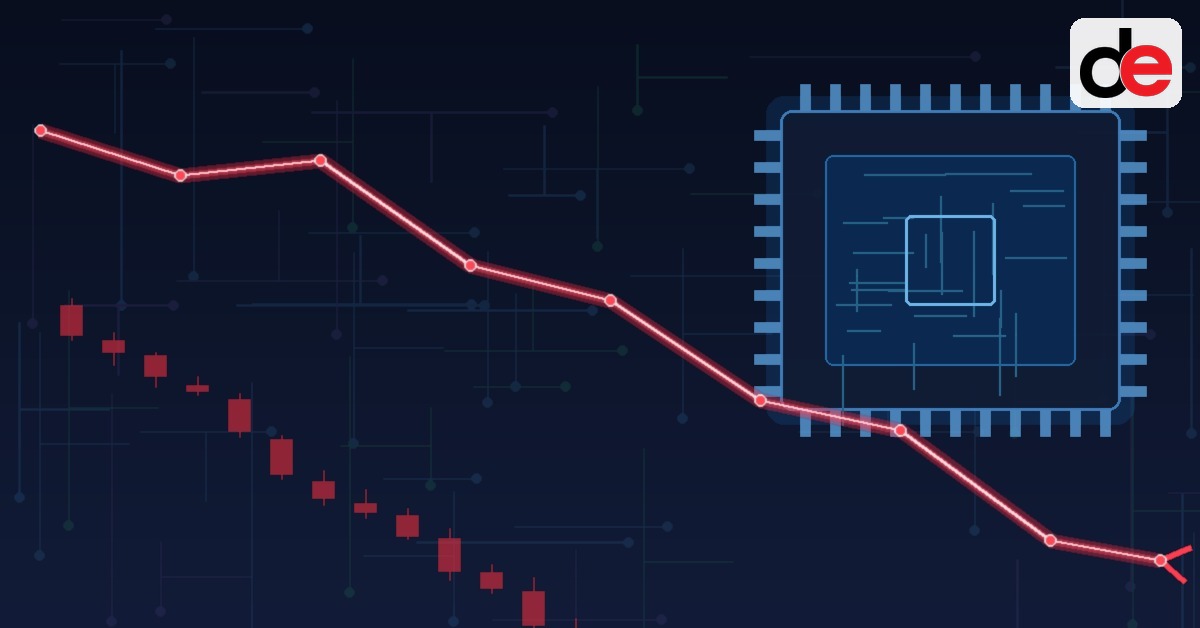
The Nvidia share price sell-off gathered pace on Wednesday, 25 November 2026, as Nvidia fell more than 5% in premarket trading and a wider rout in AI-linked stocks erased the week’s gains.
The Nvidia share price sell-off deepened on Wednesday, 25 November 2026, as investors sold chipmakers and AI-linked names before key US inflation data. Reuters reported that Nasdaq futures tumbled more than 2%, with Nvidia down 5.1% in premarket trading, Micron down 6%, and AMD and Marvell down 6.5% and 5.7%. Alphabet fell 3%, Amazon shed 3.2%, and Microsoft and Meta were down 1.9% and 1.4%.
From a record rally to a rout in 48 hours
Nvidia rallied 31.5% on Monday after its board reinstated Jensen Huang as chief executive, then lost nearly 6% on Tuesday. The Philadelphia Semiconductor Index dropped about 7.9% on Tuesday, leaving it roughly 40% below its June peak. Both indexes remained on track for their worst November since 2008, Reuters reported.
The wider retreat in AI stocks was not limited to chips. Anthropic fell 5.7% in premarket trading after closing Tuesday at $81.90, below its $83 IPO price. Reuters reported that Wall Street has been rattled this month by doubts over whether the debt-fueled boom in AI spending will generate sufficient returns.
Tariffs and the Federal Reserve add to the pressure
Fresh tariffs are adding to the caution: Reuters reported on Tuesday that the Trump administration could unveil new duties on imports from 16 major US trading partners after a probe into excess industrial capacity, further clouding the outlook for investors already facing higher rates for longer.
The PCE inflation report, due at 8:30 a.m. ET on Wednesday, is among the Federal Reserve‘s most closely watched gauges and the final major release before the year’s last Federal Open Market Committee meeting; third-quarter GDP is due at the same time. “Softer inflation might offer some relief, although markets would still need evidence that AI shares can sustain a recovery beyond a short-lived bounce,” Daniela Hathorn, senior market analyst at Capital.com, told Reuters. Fed funds futures traders were pricing in a 97% chance of a December rate hike and a 63% chance of another in January, CME Group’s FedWatch showed.
Strong orders, weak confidence
Yet demand for AI hardware still looks strong. Dell reported third-quarter revenue of $54.9 billion, up 103% from a year earlier, with AI-optimised server revenue up 291% to $22 billion and AI server orders at a record $132.3 billion. It raised its full-year AI server revenue forecast to $78 billion, yet Dell shares still fell 6%.
Hewlett Packard Enterprise said its cloud and AI operating margin reached 18.4% in the latest quarter but forecast about 14% for fiscal 2027. “We’re getting to a point in the AI trade where strong revenue growth and a growing order book may no longer be enough to excite investors,” Louis LaValle of Frontier Investments told MarketWatch.
Selling in semiconductor stocks spread to Asia: Samsung fell nearly 10%, SK Hynix lost more than 11% and Taiwan Semiconductor Manufacturing Company fell 3.6%. “The dislocation in AI-related investments is global and specifically concentrated in AI infrastructure stocks,” Sunil Garg, chief investment officer at Lighthouse Canton, told the Financial Times. AMD faces another complication: a recent SEC filing registered nearly 337 million shares for potential resale, mainly warrants granted to OpenAI and Meta. “For the broader market, one big day doesn’t necessarily make a bottom,” Charles Schwab analyst Nathan Peterson wrote on Tuesday.
What to watch next
Investors will watch the PCE and GDP releases at 8:30 a.m. ET for clues on the Federal Reserve’s next move and whether chipmakers can hold their premarket levels. US markets close for Thanksgiving on Thursday, with a shortened session on Friday, so volumes may stay thin.
The Nvidia share price sell-off is therefore a test of confidence rather than a verdict on demand. Orders for AI hardware remain at record levels, but investors are asking who pays for the build-out and when the returns arrive. Until those questions get convincing answers, the rally that followed Jensen Huang’s return looks like a pause in a wider retreat.
FAQs
Why is the Nvidia share price sell-off happening?
Investors are selling on tariff reports, doubts over returns on AI spending and expectations of higher rates. Reuters reported the Trump administration could unveil new duties on imports from 16 trading partners, while traders priced in a 97% chance of a December rate hike.
How much has Nvidia fallen this week?
Nvidia rallied 31.5% on Monday after its board reinstated Jensen Huang, then lost nearly 6% on Tuesday and fell 5.1% in premarket trading on Wednesday, 25 November 2026. The Philadelphia Semiconductor Index dropped about 7.9% on Tuesday.
What role do tariffs play in the sell-off?
Chip supply chains run through Taiwan, South Korea and other partners named in the probe. Reuters reported the administration could unveil new duties after an investigation into excess industrial capacity, raising costs and clouding the outlook for chipmakers.
Does the sell-off mean AI demand is falling?
No. Dell reported record AI server orders of $132.3 billion and raised its full-year AI server revenue forecast to $78 billion. The sell-off reflects doubts about returns and financing costs, not a collapse in orders.