
AI Quantum Gravity Theory Built With GPT-6 Astra Sparks Debate Among Physicists
AI quantum gravity took a striking new turn this week, as a Stanford physicist proposed a new framework for physics’ oldest unsolved puzzle — built with months of help from OpenAI’s GPT-6 Astra.
The AI quantum gravity story began on November 25, 2026, when Venkatesa Chandrasekaran, a theoretical physicist at Stanford University, posted an 83-page preprint on arXiv titled “An algebraic quantization of gravity from the null cone”, reported by The Times of India on November 27, 2026. A single-author paper, its acknowledgements reveal an unusual collaborator: OpenAI‘s GPT-6 Astra, which worked with Chandrasekaran for months, using about 400 million tokens of compute.
What the paper proposes
The search for quantum gravity — joining general relativity and quantum mechanics — is widely seen as the biggest open question in fundamental physics. For roughly a century, physicists have tried to join the two, and no version has won general acceptance: the straightforward quantum version of Einstein’s theory produces infinities that cannot all be removed.
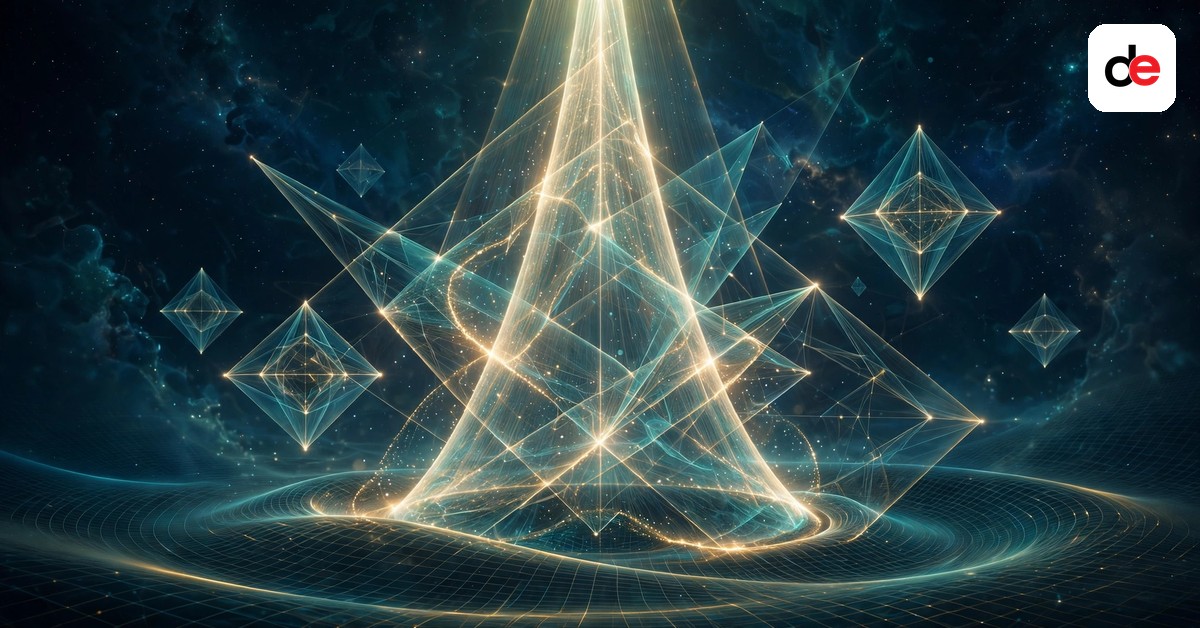
Chandrasekaran starts from the light cone — the surface traced out by a flash of light spreading outward. Two events, one earlier and one later, enclose a diamond-shaped region, a causal diamond. The paper describes all the gravity inside such a diamond using only data on its boundary, then turns what remains into a quantum system. Gluing many diamonds together builds larger regions of spacetime. The construction is background-independent — it starts from no fixed spacetime — and exact in Newton’s gravitational constant, not an approximation in small steps of it, the step that normally triggers the infinities.
The 400 million tokens behind the theory
The acknowledgements say “several of the calculations and proofs in this paper were developed through detailed, back and forth collaboration with GPT-6 Astra”, over many months, using about 400 million tokens provided by OpenAI. GPT-6 Astra is not listed as an author, and the paper does not say which calculations or proofs came from the model. The figure is a rare public data point on what a long human-AI research partnership costs in compute.
Chandrasekaran also thanked Sam Altman and Sébastien Bubeck for encouragement; GPT-6 Astra was OpenAI’s most capable model until GPT-6.2 Astra arrived in mid-November 2026.
Three checks the paper claims
The paper puts its framework through three consistency checks. First, it calculates the amplitude for a pair of gravitons — the quanta of gravitational waves — to appear on a light cone and then vanish, and finds a finite closed-form result where the traditional route diverges.
Second, it recovers black hole entropy. Bekenstein and Hawking showed in the 1970s that a black hole’s entropy is proportional to its horizon area. The paper recovers the Bekenstein-Hawking formula by counting quantum states on the light-cone surfaces, and computes the next, smaller logarithmic correction for large Schwarzschild black holes — the same coefficient the Indian string theorist Ashoke Sen worked out in 2012.
Third, it derives Einstein’s equations, with the first layer of quantum corrections, as the low-energy limit of the theory — the reduction to ordinary gravity at everyday scales that any quantum theory of gravity must achieve.
The pushback from physicists
Not everyone is convinced. Jonathan Oppenheim, writing in his Post Quantum newsletter, argued that the paper does not come close to solving quantum gravity: it does not show that the theory satisfies diffeomorphism invariance and instead imposes it as an axiom. The wider community has yet to respond in detail.
The limits matter as much as the claims. The paper is a preprint and has not yet been peer-reviewed, and quantum gravity has a long record of promising proposals running into trouble under expert scrutiny. The framework covers only vacuum general relativity — gravity without matter — and no experiment can settle the question, because its effects appear at energies far beyond any particle collider.
What happens next
The AI quantum gravity episode shows how far AI collaboration in science has come: an AI model is now credited in a paper attacking the hardest problem in physics. But the theory will stand or fall on scrutiny, not on the token count. Consistency is not the same as truth: what would decide it is a prediction that differs from other approaches and is then measured.
FAQs
What is AI quantum gravity?
It is the story of a Stanford physicist using OpenAI’s GPT-6 Astra to propose a new quantum theory of gravity. Venkatesa Chandrasekaran posted the 83-page preprint on arXiv on November 25, 2026, after months of collaboration with the model that used about 400 million tokens.
How did GPT-6 Astra help with the quantum gravity paper?
The paper’s acknowledgements say several of its calculations and proofs were developed through detailed, back-and-forth collaboration with GPT-6 Astra over many months, using roughly 400 million tokens provided by OpenAI. The model is not listed as an author, and the paper does not say which parts came from it.
Has the quantum gravity theory been proven?
No. It is a preprint that has not yet been peer-reviewed, and there is no experimental test for quantum gravity, because its effects appear at energies far beyond any particle collider. Its checks are consistency checks, not observational proof.
Why are some physicists skeptical of the new theory?
Jonathan Oppenheim argued in his Post Quantum newsletter that the paper does not come close to solving quantum gravity: it does not show that the theory satisfies diffeomorphism invariance and instead imposes it as an axiom. The framework also covers only vacuum gravity, and quantum gravity has a long record of promising proposals running into trouble under scrutiny.